
Introduction
Every business generates documents as part of its daily operations. From financial statements and employee records to invoices, contracts, purchase orders, tax documents, and customer information, paperwork continues to accumulate as a company grows. Although many business processes have become digital, physical documents still play an important role in several industries. Managing these records over multiple years can become challenging, particularly when office space is limited.
Without a proper document management plan, files can become disorganised, important records may be difficult to locate, and storage cabinets can gradually occupy valuable workspace. Businesses may also need to retain certain records for specific periods depending on legal, regulatory, contractual, or operational requirements.
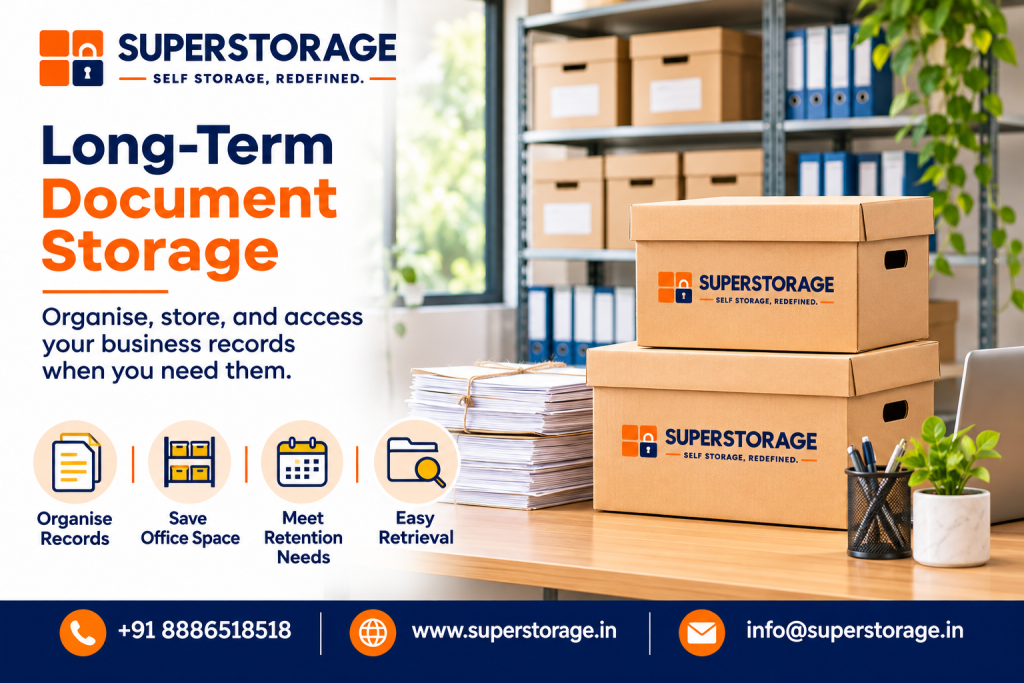
A structured approach to long-term document storage helps businesses organise their records, manage physical space, and improve document accessibility when required. Instead of allowing archived paperwork to accumulate inside offices, companies can explore dedicated storage arrangements. SuperStorage helps businesses consider additional space for accepted documents and other business belongings according to their requirements and available services.
Why Long-Term Document Storage Matters for Businesses
Documents provide a record of business activities, decisions, transactions, and responsibilities. Even when a company no longer uses a particular file regularly, the information it contains may still be important for future reference.
For example, finance departments may need previous invoices and accounting records when reviewing transactions. Human resources teams may need to refer to historical employee documentation, while legal and administrative departments may require older contracts, agreements, and correspondence.
As businesses operate over several years, the number of archived documents can increase significantly. Keeping every file in active office areas makes it difficult to maintain an organised working environment.
A planned storage arrangement allows businesses to distinguish between frequently accessed documents and records that need to be retained but are rarely used. This helps reduce office congestion while ensuring that important paperwork is organised according to the company’s requirements.
Understand Which Documents Need Long-Term Retention
Before creating a document storage plan, businesses should identify the types of records they generate and determine which ones need to be retained.
Financial records may include invoices, payment receipts, expense statements, tax-related documents, and accounting reports. Administrative records may include company policies, official correspondence, agreements, and operational documents. Human resources departments may maintain employment contracts, payroll documentation, and other employee-related records.
Businesses in industries such as healthcare, education, manufacturing, logistics, and financial services may also maintain specialised documentation connected to their operations.
However, not every document needs to be retained indefinitely. Retention periods can vary depending on applicable laws, regulatory requirements, contractual obligations, and the nature of the records. Businesses should consult qualified legal, tax, or compliance professionals when determining the appropriate retention period.
Creating a document classification system helps identify which files should remain accessible, which can be archived, and which may be eligible for disposal after the applicable retention period.
Create a Structured Document Classification System
One of the biggest challenges in long-term document management is locating a particular file among hundreds or thousands of archived records. Without a consistent classification method, employees may spend considerable time searching through cartons, cabinets, and folders.
Businesses should organise documents according to department, year, document type, project, or another system that suits their operations. For example, finance records can be grouped by financial year, while employee documents can be organised according to approved internal identification procedures.
Every storage carton should have a clear label that indicates its contents, date range, department, and reference number. A consistent naming system makes it easier to identify documents without opening every carton.
A digital inventory can further improve organisation. It can record carton numbers, document categories, storage locations, retention dates, and responsible departments. This provides employees with a reference point when they need to retrieve an archived file.
SuperStorage helps businesses explore additional space for accepted physical documents. Preparing a clear inventory before arranging storage can make it easier to estimate requirements and organise records for future reference.
Separate Active Documents From Archived Records
Not all business documents require the same level of accessibility. Some files are used every day, while others may only be required during audits, reviews, or specific business situations.
Keeping active and archived documents together can create unnecessary clutter. Employees may have to search through older records to locate current paperwork, while frequently used office areas become occupied by documents that are rarely accessed.
A practical approach is to retain frequently used files within the office and organise older records separately. For example, a finance team may keep current financial-year documents close to its working area while arranging previous records for longer-term retention.
This separation helps employees use office space more efficiently and makes document management easier. Businesses should also establish clear procedures for transferring files between active and archived categories so that important records are not misplaced.
Protect Physical Documents From Environmental Damage
Paper documents can deteriorate when exposed to unsuitable environmental conditions. Moisture, excessive heat, dust, direct sunlight, and pests may affect paper quality, printed information, folders, and cartons.
Before arranging long-term document storage, businesses should ensure that records are clean, dry, and properly organised. Avoid placing paperwork in damp cartons or packing documents while they are wet. Use suitable document boxes and keep files organised so that they can be identified and handled appropriately.
Important records should not be folded unnecessarily or packed in a way that places excessive pressure on them. Where documents require specialised preservation conditions, businesses should seek professional archival guidance rather than assuming that ordinary storage arrangements will be sufficient.
When evaluating a storage provider, ask about the available storage environment and whether it is appropriate for paper records. SuperStorage customers should discuss their document requirements and confirm the applicable conditions before arranging storage.
Maintain a Document Inventory and Retrieval Process
A long-term storage plan should explain not only where documents are kept but also how they can be located and retrieved.
Businesses should maintain a central inventory containing information about archived records. Each carton or file group should have a unique reference number that corresponds with the digital record. The inventory can include the document category, department, date range, storage location, retention period, and person responsible for the records.
For example, if an auditor requests a particular set of financial records, the employee responsible should be able to identify the relevant carton through the inventory rather than searching through every stored box.
It is also useful to maintain a record of documents that are removed from storage and returned later. This creates a clear history of document movement and helps businesses maintain accountability.
Before selecting an external storage arrangement, confirm the provider’s access conditions, retrieval procedures, scheduling requirements, and applicable charges. These details are important when archived documents may occasionally be required at short notice.
Improve Office Space Management Through External Document Storage
As businesses expand, office space becomes increasingly valuable. Workstations, meeting rooms, equipment, and employee facilities often require more room as teams grow. However, archived paperwork can occupy significant portions of the available office area.
Renting a larger office solely to accommodate documents that are rarely accessed may not always be practical. It can introduce additional rental expenses, maintenance responsibilities, and other property-related costs.
External document storage can be considered when the primary requirement is to retain physical records without keeping them inside the main workplace. This allows businesses to use their existing premises more effectively while maintaining an organised system for archived paperwork.
SuperStorage helps businesses explore additional space for accepted documents and other business belongings. Companies can discuss their approximate carton quantity, storage duration, and requirements to understand the available arrangements.
This can be particularly useful for small and medium-sized businesses that generate substantial paperwork but have limited office space.
Establish Document Retention and Disposal Policies
Long-term document storage should not become a reason to retain every file forever. Over time, unnecessary paperwork can accumulate and increase storage requirements.
Businesses should establish a document retention policy that explains how long different categories of records need to be maintained. The policy should reflect applicable legal and regulatory requirements, contractual obligations, and internal business needs.
Regular reviews can help identify records that have reached the end of their approved retention period. Before disposing of any documents, businesses should confirm that they are no longer required for audits, investigations, legal matters, tax obligations, or other legitimate purposes.
Documents containing confidential or personal information should be disposed of through an appropriate process, such as professional shredding, according to the organisation’s policies and applicable requirements.
A clear retention and disposal process prevents unnecessary accumulation and helps businesses manage long-term storage requirements more efficiently.
Consider Digitisation Alongside Physical Storage
Digitisation can complement physical document storage by making frequently referenced information easier to access. Businesses can scan selected records and maintain digital copies through an appropriate document management system.
Digital records can be organised using searchable filenames, document categories, dates, and reference numbers. This may reduce the need to retrieve physical files for routine reference.
However, digitisation does not automatically remove the need to retain original paperwork. Certain documents may need to be maintained in their original form depending on legal, regulatory, contractual, or operational requirements.
Businesses should also consider access permissions, backup arrangements, data protection, and cybersecurity when managing digital records.
A combination of organised physical archives and appropriate digital document management can provide a more practical approach to handling large volumes of business paperwork.
How SuperStorage Helps Businesses With Long-Term Document Storage
Managing years of business records requires planning, organisation, and sufficient space. When office cabinets and storage rooms become overcrowded, businesses may need to consider alternatives that allow them to retain physical documents without affecting everyday operations.
SuperStorage helps businesses explore available storage arrangements for accepted documents and other business belongings. Companies can discuss their requirements based on the quantity of paperwork, expected storage duration, and available services.
Before booking, businesses should confirm the accepted document categories, storage conditions, pricing, access arrangements, retrieval procedures, and any applicable service terms. They should also maintain their own document inventory and retention records to support organised record management.
Whether you are a startup building your first archive, a growing company managing several years of paperwork, or an established organisation looking to free up office space, SuperStorage can help you explore suitable additional storage options.
Conclusion
Long-term document storage is an important part of effective business administration. As companies grow, physical records can accumulate and occupy valuable office space. Without a structured approach, documents may become difficult to locate, retention requirements may be overlooked, and everyday operations can become less organised.
Businesses can address these challenges by classifying records, separating active files from archived documents, maintaining digital inventories, following appropriate retention policies, and planning document retrieval procedures. Digitisation can also complement physical archives where suitable.
With SuperStorage, businesses can explore practical options for managing accepted physical documents outside their primary workspace. A well-planned document storage arrangement helps organisations maintain better control over their records, make more effective use of office space, and prepare for future documentation requirements.