
Introduction
Corporate relocation is an important milestone for any organisation. Businesses may move to a larger office, shift to a different commercial building, consolidate multiple branches, or relocate to a new city to support their growth. While relocating creates opportunities to improve workplace operations, the transition also involves several logistical challenges. One of the biggest concerns is managing office equipment and furniture between the time the existing premises are vacated and the new workplace is ready.
Office desks, chairs, computers, printers, monitors, filing cabinets, conference tables, networking equipment, and other business assets require proper planning during relocation. Moving everything directly to the new office may not always be possible, especially when renovation, electrical work, interior installation, or infrastructure preparation is still underway.
This is where temporary office storage becomes useful. Instead of rushing the relocation or overcrowding an unfinished workplace, businesses can explore temporary storage arrangements for eligible equipment and furniture. SuperStorage helps organisations consider additional storage options based on their relocation requirements, available plans, and location.
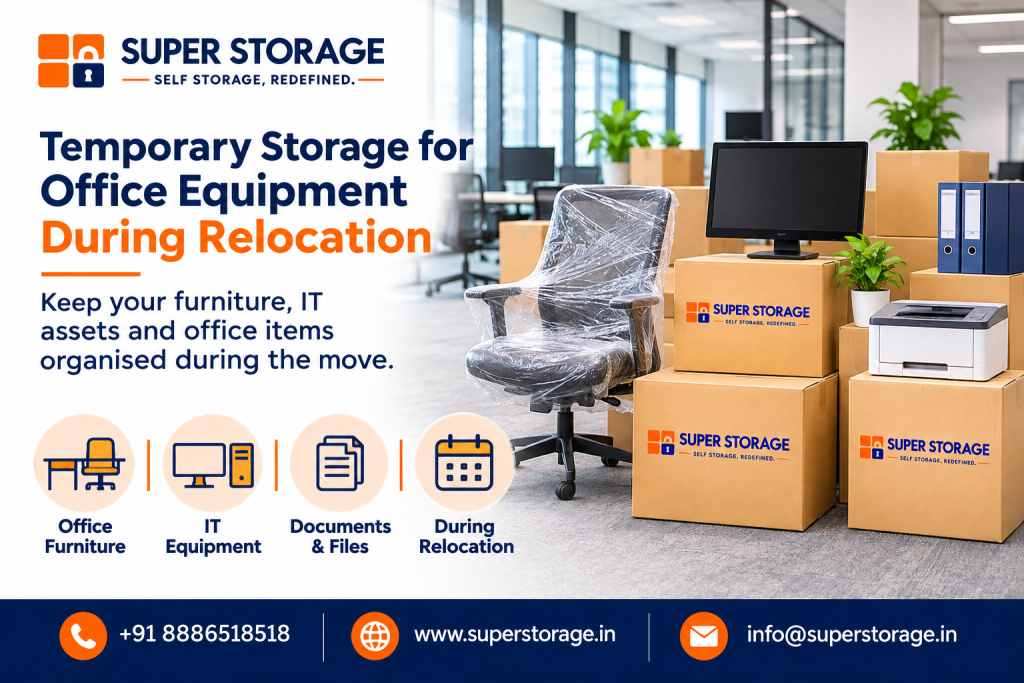
Why Temporary Storage Is Important During Corporate Relocation
Corporate relocation rarely happens in a single day. Businesses often need to coordinate employee schedules, transportation, building access, technology installation, furniture arrangements, and administrative activities. The existing office may need to be vacated before the new premises are completely ready.
During this transition, office equipment can become difficult to manage. Keeping desks, chairs, computers, and cartons at a temporary workplace may create space constraints. Moving everything directly to the new location before installation work is completed can also complicate the process.
Temporary storage provides an alternative arrangement for selected belongings during this period. Businesses can organise equipment separately and coordinate its delivery when the new premises are ready.
SuperStorage offers storage options that businesses can explore for eligible office furniture, equipment, and other belongings. This can help organisations manage the physical side of relocation while focusing on their operational priorities.
Identify the Office Equipment That Needs Storage
The first step in planning temporary storage is identifying which office assets need to be moved. Not every item will necessarily require storage. Some equipment may be transferred directly to the new premises, while other items may need to remain temporarily outside the workplace.
Prepare an inventory of office furniture, workstations, chairs, conference tables, filing cabinets, printers, monitors, computers, and other equipment. Separate items according to their departments or intended locations in the new office.
For example, a company relocating its finance department may need to manage filing cabinets, workstations, computers, and office chairs. A technology company may have additional monitors, networking equipment, servers, and electronic accessories that require specific handling arrangements.
Record the quantity, approximate dimensions, and condition of each item. Photographs can also help identify equipment during collection and delivery.
Sharing this inventory with SuperStorage can help communicate the scale of the requirement and provide a clearer basis for discussing available storage options.
Store Office Furniture During the Transition
Office furniture generally occupies a significant amount of space during corporate relocation. Desks, chairs, workstations, reception counters, conference tables, storage cabinets, and partitions can be difficult to accommodate when the new premises are not ready.
If furniture is moved directly into an office undergoing renovation, it may obstruct painting, flooring, electrical installation, or interior work. Temporary storage can help businesses manage these items until the workplace is prepared.
Before arranging storage, clean furniture surfaces and identify detachable components. Where suitable, dismantle desks, tables, and modular workstations according to the manufacturer’s instructions. Keep screws, bolts, fittings, and other small components in labelled bags associated with the corresponding furniture.
Use appropriate protective covers for furniture surfaces and ensure that items are dry before packing. Fragile or specialised furniture may require additional preparation.
SuperStorage helps businesses explore furniture storage arrangements based on the quantity and type of eligible items, making it easier to plan the transition between office locations.
Manage Computers and Electronic Equipment Carefully
Electronic equipment is among the most important assets to consider during corporate relocation. Computers, laptops, monitors, printers, scanners, projectors, and networking devices require careful preparation before transportation or temporary storage.
Before packing, ensure that important business data is backed up according to the organisation’s IT policies. Disconnect cables and accessories, label them clearly, and keep related components together. Use original packaging where available or suitable protective materials to minimise movement during transportation.
Electronic equipment may have specific temperature, humidity, handling, and power-related requirements. Follow the manufacturer’s instructions and confirm that the intended storage arrangement is appropriate for the equipment.
Businesses should also review their data security procedures before moving computers and storage devices. Confidential information, access credentials, and sensitive company records should be managed separately through approved IT processes.
Before including electronics in a SuperStorage booking, confirm whether the specific equipment is accepted and whether the selected service meets its handling requirements.
Organise Office Documents and Files
Corporate relocation often involves moving physical documents, archived files, employee records, invoices, contracts, and administrative paperwork. These materials may need to be retained even when they are not required for everyday operations.
Before placing documents into storage, review them according to the organisation’s document retention policies. Separate essential records that employees may need during relocation from files that can be archived.
Use strong cartons and organise documents by department, year, or category. Label every carton clearly and maintain a corresponding digital inventory. Confidential records should be handled according to the company’s information security and access-control requirements.
Important original documents and sensitive records may require specialised arrangements. Businesses should confirm whether the proposed storage service is appropriate for the type of documents involved.
SuperStorage can help organisations understand available options for eligible business belongings and selected office materials, subject to the applicable service policy.
Plan Storage According to the Relocation Timeline
The duration of temporary storage depends on how quickly the new office becomes operational. Some businesses may need storage for a few weeks while interiors are completed, whereas larger corporate relocations may require several months of coordination.
Before requesting a quote, prepare an estimated relocation timeline. Consider when the existing premises must be vacated, when renovation work will be completed, and when furniture and equipment can be delivered to the new location.
It is also useful to consider possible delays. Construction schedules, electrical work, internet installation, furniture assembly, and building approvals may affect the planned move-in date.
Discuss the expected storage duration and extension terms before booking. SuperStorage helps businesses explore available plans according to their anticipated requirements and selected service location.
A clear timeline makes it easier to coordinate collection, storage, and eventual delivery.
Estimate the Space Required for Office Equipment
Accurately estimating storage space is important before requesting a quote. Office equipment comes in different shapes and sizes, so simply counting the number of items may not provide a reliable estimate.
Measure large furniture pieces such as conference tables, workstations, reception counters, cabinets, and office chairs. Record the dimensions of cartons containing documents, cables, accessories, and smaller equipment.
Consider whether furniture can be dismantled to reduce the space required. Also account for protective wrapping and packaging materials, which may increase the overall dimensions of certain items.
Prepare photographs and an inventory with approximate measurements. This information can help the storage provider understand the quantity and type of belongings involved.
SuperStorage can use the details shared by businesses to help explain available storage arrangements and guide them through the quotation process.
Coordinate Pickup and Delivery Between Office Locations
Transportation is an important part of corporate relocation. Businesses need to coordinate the movement of equipment from the existing premises to temporary storage and later to the new office.
Before scheduling collection, confirm the pickup address, building access arrangements, collection date, and approximate quantity of belongings. Inform the relevant facility management teams about the planned movement of large furniture and equipment.
When the new office is ready, coordinate delivery according to the installation schedule. For example, furniture may need to arrive before employee workstations are configured, while selected electronic equipment may be delivered after the IT infrastructure is prepared.
SuperStorage helps customers understand available pickup and delivery arrangements depending on the selected service and location. Discussing transportation requirements in advance can make coordination easier.
Businesses should also confirm the applicable service charges, delivery timelines, and procedures for changes to the original schedule.
Maintain an Asset Inventory Throughout the Process
When multiple departments and large quantities of equipment are involved, maintaining an accurate asset inventory becomes especially important.
Assign identification numbers to furniture, computers, monitors, and other valuable equipment. Record the item description, department, condition, and intended destination. Take photographs before collection and update the inventory when items are delivered.
For smaller accessories, use labelled cartons and maintain a record of their contents. Keep copies of collection confirmations, booking details, and other relevant service documents.
An organised inventory helps businesses identify missing items, track equipment movement, and coordinate delivery to the correct departments.
SuperStorage customers can use their own inventory records to communicate storage requirements and organise their belongings throughout the temporary arrangement.
Important Things to Check Before Booking Office Storage
Before confirming a storage service, businesses should understand the applicable terms and conditions. Check which office items are accepted, the available storage duration, facility conditions, payment schedule, and retrieval procedures.
For electronic equipment, confirm whether the intended arrangement is appropriate for the manufacturer’s handling and environmental requirements. Businesses should also understand how confidential documents and data-bearing devices will be managed.
Ask whether pickup, transportation, and delivery are included in the quotation or charged separately. Clarify any additional fees, changes to the schedule, and extension charges that may apply.
SuperStorage helps businesses understand available options based on their requirements and the selected service. Discussing these details before booking can help organisations make an informed decision.
How SuperStorage Supports Corporate Relocation
Corporate relocation involves several moving parts, and managing office equipment between two premises can add to the workload of administrative, operations, and facilities teams.
SuperStorage helps businesses explore temporary storage options for eligible office furniture, equipment, cartons, and other business belongings. Organisations can share their inventory, approximate quantities, item dimensions, and expected storage duration to understand the available arrangements.
Depending on the service and location, businesses can also discuss pickup and delivery requirements. This provides an additional option when the existing office has been vacated but the new workplace is not yet ready to receive all equipment.
Whether your organisation is moving to a larger office, renovating its premises, or consolidating departments, SuperStorage can help you explore storage arrangements that support your relocation plans.
Conclusion
Temporary storage can play an important role in managing office equipment during corporate relocation. Furniture, computers, printers, documents, workstations, and other business assets may need to remain outside the workplace while renovation, installation, and infrastructure activities are completed.
By preparing an asset inventory, measuring bulky equipment, organising documents, following appropriate packing procedures, and planning the relocation timeline, businesses can make the transition more manageable.
SuperStorage helps organisations explore storage options for eligible office furniture and equipment based on their requirements. With proper planning and a suitable temporary arrangement, businesses can coordinate their relocation more effectively and prepare their new workplace without rushing the movement of every asset.