
Introduction
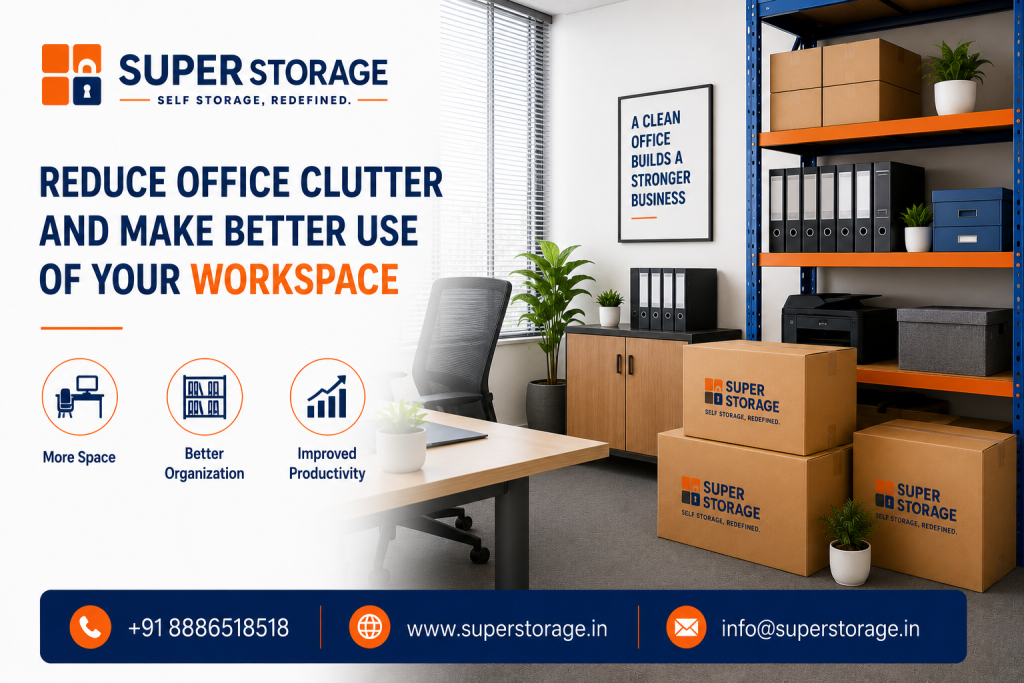
An organized office can make a significant difference to the way a business operates. When employees have enough room to work, move around, collaborate, and access the items they need, the workplace can feel more efficient and comfortable. However, offices often accumulate belongings over time. Old files, unused furniture, extra chairs, outdated electronics, promotional materials, archived documents, office supplies, spare equipment, event items, and miscellaneous boxes can gradually occupy valuable workspace. What begins as a few items kept temporarily can eventually turn into a cluttered office where desks become crowded and storage cabinets overflow. For businesses that are growing or working with limited floor space, this can become a real challenge. Not every item needs to be discarded simply because it is not being used today. Some belongings may still be required in the future, while others may need to be retained for business purposes. This is where office storage can provide a practical solution. At SuperStorage, we help businesses and professionals manage suitable office belongings when they need additional space during relocation, renovation, expansion, downsizing, office restructuring, or general decluttering. By moving rarely used items into storage, businesses can make better use of their existing workspace without permanently getting rid of useful possessions.
Why Office Clutter Builds Up Over Time
Office clutter rarely appears overnight. It usually develops gradually as a business grows and changes.
A company may purchase additional chairs for new employees, keep old desks after upgrading furniture, store files that are no longer accessed regularly, or retain equipment for future projects.
Marketing materials from previous campaigns may remain in cupboards. Old computers may be kept as backup equipment. Extra stationery may accumulate because different departments purchase supplies separately.
Individually, these items may seem manageable. Together, they can consume a considerable amount of office space.
Without a regular decluttering process, unused belongings can eventually become part of the everyday office environment.
Make Better Use of Your Existing Office Space
Expanding into a larger office is not always the first solution to a space problem.
Sometimes, the existing workspace contains a significant amount of equipment and furniture that is simply not being used regularly.
By reviewing what is actually required every day, businesses can identify belongings that can be moved elsewhere.
Suitable items can be stored separately, allowing the office to become more open and functional.
At SuperStorage, we help businesses manage suitable belongings according to applicable storage policies, making it easier to organize items that are not currently required on-site.
Start With an Office-Wide Assessment
The first step in reducing clutter is understanding what is actually occupying the office.
Walk through workstations, meeting rooms, storage rooms, reception areas, kitchens, utility spaces, and other sections of the workplace.
Look at cupboards, shelves, cabinets, corners, and unused areas.
Create categories such as frequently used, occasionally used, archive, surplus, damaged, obsolete, and items to be removed.
This gives your team a clearer picture of how much space is being occupied by belongings that are not part of everyday operations.
Store Extra Office Furniture
Furniture can take up a substantial amount of office space.
Businesses often keep spare desks, chairs, cabinets, tables, shelves, partitions, and other furniture because they may need them when the company expands.
However, storing several unused desks or chairs inside an already crowded office may not be the best use of available floor space.
Suitable furniture can be moved into storage until it is required again.
At SuperStorage, we help businesses manage suitable furniture during office moves, renovations, restructuring, and expansion.
Make Room for New Employees
Business growth often creates an interesting challenge. A company may need additional workstations for new employees but have no room because unused furniture and equipment are already occupying the office.
Instead of purchasing a larger office immediately, review your existing belongings.
You may find that several desks, chairs, cabinets, or computers are not currently in use.
Storing suitable surplus items can create room for new workstations and allow the business to use its current office more effectively.
Manage Archived Files
Documents and files can consume enormous amounts of office space.
Businesses may need to retain certain records for operational, legal, financial, or other reasons, even when employees rarely access them.
Keeping years of archived paperwork inside active work areas can result in overflowing cabinets and shelves.
Businesses should determine their own document-retention requirements and applicable obligations before moving records into storage.
Where appropriate, archived documents can be organized, labelled, inventoried, and managed separately from everyday files.
Keep Current Files Accessible
Not every document should be moved away from the office.
Files that employees access regularly should remain readily available.
A useful approach is to separate active documents from archived records.
This can help employees find current information quickly while reducing the amount of paperwork occupying desks and cabinets.
Proper organization can make the office feel significantly less crowded.
Store Unused Electronics
Businesses often accumulate old monitors, desktop computers, printers, keyboards, networking equipment, projectors, speakers, and other electronics.
Some equipment may still function but is not currently needed.
If the business intends to retain these devices for future use, suitable items can be considered for storage.
Before storing electronics, follow manufacturer recommendations, back up important information where necessary, and manage sensitive business data appropriately.
Businesses should also ensure that obsolete equipment is handled through appropriate recycling or disposal channels rather than simply storing items indefinitely.
Reduce Clutter in Meeting Rooms
Meeting rooms can become storage areas when offices lack dedicated space.
Extra chairs, unused projectors, promotional materials, event equipment, boxes, and spare furniture may gradually accumulate.
This can reduce the room’s usefulness for meetings and collaboration.
Review everything currently occupying the room and determine what actually needs to remain there.
Suitable occasional-use belongings can be moved into storage so the meeting room can return to its intended purpose.
Clear Reception Areas
The reception area creates the first impression for visitors and clients.
Boxes, spare furniture, promotional materials, and miscellaneous office items can make the area appear crowded.
Keep the reception area focused on its primary function.
Items that are needed only occasionally can be organized elsewhere, including suitable storage arrangements.
A clearer reception area can contribute to a more professional and welcoming workplace environment.
Organize Promotional Materials
Businesses often keep banners, display stands, brochures, event materials, branded merchandise, exhibition equipment, and promotional items.
These materials may be valuable during marketing campaigns, conferences, trade shows, or corporate events but may not be required every day.
Instead of occupying an office room throughout the year, suitable promotional materials can be packed and labelled for storage.
When a campaign or event approaches, the required materials can be retrieved.
Store Event and Exhibition Equipment
Companies that regularly participate in exhibitions may accumulate display panels, stands, tables, lighting equipment, branded backdrops, and other event materials.
Keeping all of this equipment inside the office can reduce available workspace.
Create a clear inventory of event equipment and separate frequently used items from occasional-use materials.
Suitable items can be stored until the next exhibition or corporate event.
Manage Office Supplies
Excess stationery is another common source of office clutter.
Pens, notebooks, printer paper, folders, envelopes, packaging materials, and other supplies can accumulate when businesses purchase in bulk.
Instead of allowing supplies to overflow from cupboards, establish a simple inventory system.
Keep the quantities required for regular operations accessible and manage excess supplies separately where appropriate.
Store Furniture During Office Renovation
Office renovations often require furniture and equipment to be moved temporarily.
Desks, chairs, cabinets, computers, and other belongings may need to be cleared from rooms while flooring, painting, electrical work, partitions, or other improvements are completed.
Moving everything into another office area can simply transfer the clutter.
At SuperStorage, we help businesses manage suitable belongings during office renovation projects, allowing them to keep selected items separate while work is underway.
Office Relocation and Temporary Storage
Moving to a new office can also create temporary storage requirements.
Your current lease may end before the new office is completely ready. The new location may be smaller, undergoing renovation, or not yet equipped to accommodate all your furniture.
Instead of repeatedly moving belongings between temporary locations, suitable office furniture, boxes, equipment, and other possessions can be stored until the new workspace is ready.
This can simplify the transition.
Downsizing an Office
Businesses sometimes move into smaller offices to reduce operating costs or adapt to hybrid work arrangements.
When this happens, there may be more furniture and equipment than the new space can accommodate.
Not every item needs to be discarded immediately.
Businesses can store suitable furniture and equipment while determining what will be needed in the future.
This provides flexibility if the company expands again.
Hybrid Work and Reduced Office Use
The rise of hybrid work has changed how many businesses use office space.
Some employees may work remotely for part of the week, leaving desks and equipment underused.
As office layouts evolve, businesses may discover that they have more furniture and equipment than they currently need.
Rather than filling storage rooms with unused items, consider organizing suitable belongings separately.
This can allow the office layout to be redesigned around how employees actually work today.
Create a More Productive Workspace
A cluttered workspace can make it harder for employees to find things quickly.
When files are stacked around desks and unused equipment occupies walkways, employees may spend time searching for items or moving belongings around.
Reducing unnecessary physical clutter can help create a more practical environment.
The goal is not to remove everything from the office. It is to ensure that the available space is being used for activities that support the business.
Store Seasonal Office Items
Some office belongings are used only during specific periods.
Festival decorations, annual event materials, seasonal displays, exhibition equipment, and promotional items may remain unused for much of the year.
These items can be organized into labelled boxes and considered for storage.
When the relevant season or event arrives, they can be retrieved.
Keep Business Belongings Organized
Storage becomes more useful when businesses maintain clear records.
Create an inventory of furniture, equipment, boxes, promotional materials, and other stored items.
Assign labels to boxes and keep related belongings together.
For example, exhibition equipment can be grouped together, while archived files and office furniture can have separate categories.
This can make future retrieval easier and reduce unnecessary searching.
Prepare Items Before Storage
Before storing office belongings, clean and prepare them appropriately.
Furniture should be cleaned and dried before storage. If desks, chairs, or cabinets can be safely dismantled, keep screws and fittings together in labelled bags.
Electronics should be prepared according to manufacturer recommendations.
Documents should be organized into suitable folders or boxes.
Businesses should maintain records of what has been stored and where it is located.
Protect Business Information
Office storage also requires attention to confidentiality.
Businesses should carefully review files, computers, storage devices, and documents before moving them.
Remove or securely manage sensitive information according to company policies and applicable requirements.
Do not assume that simply moving a box into storage resolves information-security responsibilities.
A clear internal process should determine which records can be stored, who can access them, and how long they need to be retained.
Do Not Store Obsolete Items Forever
Decluttering should include an evaluation of whether belongings still have business value.
Broken furniture, outdated promotional materials, obsolete electronics, damaged supplies, and items that are no longer relevant may not need to be stored indefinitely.
Consider appropriate recycling, resale, donation, or responsible disposal options.
Storage should primarily be used for belongings that the business genuinely intends to retain.
Make Storage Part of Office Planning
Instead of waiting until the office becomes overcrowded, businesses can include storage in their workplace planning.
Whenever new furniture or equipment is purchased, consider what will happen to the older items.
When employees leave, review unused equipment and furniture.
After an office renovation, decide which items should return to the workspace and which can remain stored.
This creates a more consistent approach to managing physical assets.
How SuperStorage Helps Businesses
At SuperStorage, we understand that businesses can have changing space requirements.
A company may need extra room during an office renovation, additional space while relocating, temporary storage during downsizing, or somewhere to manage surplus furniture and equipment.
We help businesses manage suitable belongings according to applicable storage policies.
Depending on acceptance requirements, this may include office furniture, packed boxes, suitable electronics, documents, promotional materials, event equipment, décor, and other accepted items.
Our office storage solutions in Bangalore can help businesses create more usable workspace without immediately getting rid of belongings that may have future value.
Storage for Growing Businesses
Growing companies often need to balance expansion with efficient space management.
Before moving to a larger office, review your existing workspace.
If significant areas are occupied by rarely used belongings, storage may help free up room for employees and operational activities.
This can provide additional flexibility while the business determines its longer-term space requirements.
Storage for Small Offices
Small businesses often face the greatest space constraints.
A small office may not have a dedicated archive room, equipment room, or furniture storage area.
Every square metre matters.
Managing rarely used belongings through an appropriate storage arrangement can help small businesses maintain a functional workspace without requiring immediate expansion.
Reclaim Your Office for Its Purpose
An office should primarily support work.
Desks should provide room for employees. Meeting rooms should support collaboration. Reception areas should welcome visitors. Storage rooms should contain organized supplies rather than random boxes.
When unused belongings are moved out of active areas, the entire workplace can become more functional.
You are not necessarily changing the size of the office. You are changing how effectively you use the space you already have.
Conclusion
Office clutter can develop gradually, but its impact can become significant. Old files, extra furniture, unused electronics, promotional materials, event equipment, office supplies, boxes, and surplus belongings can occupy valuable workspace that could otherwise support employees and business activities.
The answer is not always to throw everything away or immediately rent a larger office. Some belongings may still have future value, particularly furniture and equipment that could be needed when the company expands, relocates, renovates, or changes its workplace structure.
Start by reviewing your office room by room. Separate frequently used belongings from occasional-use items, identify documents that need to be retained, review surplus furniture and equipment, and remove items that no longer have any purpose.
Suitable belongings can then be organized, labelled, inventoried, and considered for storage.
At SuperStorage, we help businesses and professionals manage suitable office belongings during relocation, renovation, expansion, downsizing, hybrid-work changes, and general decluttering. Our office storage solutions in Bangalore can help you create more usable workspace while keeping selected belongings available for future needs.
A more organized office can make everyday operations easier and allow your team to use the workplace for what it was designed to do.