
Introduction
Even in an increasingly digital business environment, physical documents continue to play an important role in everyday office operations. Contracts, invoices, employee records, financial statements, purchase orders, customer files, legal documents, and administrative paperwork are still maintained by many organisations. Over time, these records can accumulate and occupy valuable office space, making it difficult to maintain an organised working environment.
When documents are stored without a proper system, employees may spend unnecessary time searching for files, important paperwork can become difficult to locate, and office cabinets can quickly become overcrowded. For businesses operating with limited workspace, managing physical records efficiently is essential.
The solution is not simply to discard paperwork or move everything into digital formats. Businesses need a practical document management approach that combines organised filing, appropriate retention practices, digitisation, and additional space when required. SuperStorage helps businesses manage space requirements by offering storage solutions for items such as physical records and documents, subject to applicable service conditions. With the right approach, organisations can maintain accessible working areas while keeping important paperwork organised.
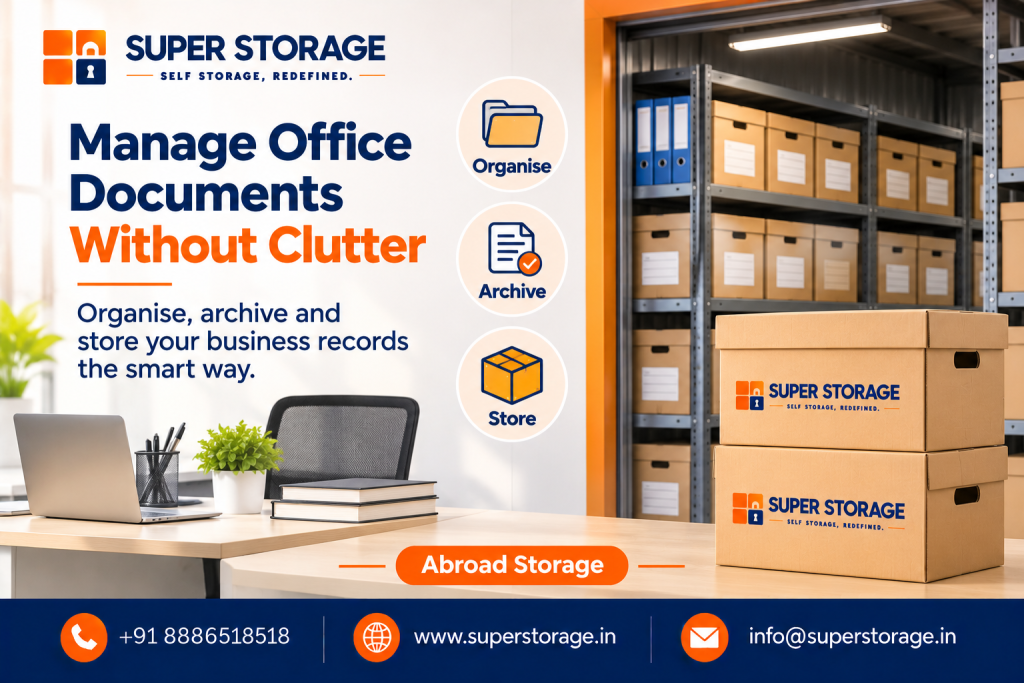
Understand the Types of Documents Your Office Maintains
The first step towards managing physical documents is understanding what your office actually needs to retain. Different departments generate different types of paperwork, and not every document needs to remain in the same location.
For example, the finance department may maintain invoices, tax-related records, payment receipts, and financial statements. The human resources department may handle employee files, appointment letters, attendance records, and payroll documentation. Operations teams may maintain purchase orders, delivery records, supplier agreements, and inventory reports.
Start by reviewing the documents maintained by each department. Identify which records are used frequently, which are required occasionally, and which need to be retained for a specific period. This classification helps businesses decide what should remain within the office and what can be moved to a separate document storage arrangement.
SuperStorage can help businesses that need additional space for physical records by offering storage options based on their requirements. Understanding the quantity and type of documents before arranging storage makes the process easier to plan.
Separate Active Records from Archived Documents
One common reason offices become cluttered is that frequently used documents and old records are kept together. Files from previous financial years may occupy the same cabinets as documents required for current projects, making everyday filing and retrieval unnecessarily difficult.
A better approach is to separate active records from archived documents. Active records are those employees regularly need for daily operations, meetings, audits, and ongoing business activities. These should remain within the office in clearly labelled cabinets or filing systems.
Archived documents are records that are no longer required regularly but must be retained for business, legal, financial, or administrative reasons. These files can be organised separately and moved to an appropriate storage arrangement after checking the applicable retention requirements.
This separation reduces the amount of paperwork occupying desks and frequently accessed cabinets. SuperStorage supports businesses looking for additional space for documents that do not need to remain in their everyday working areas.
Create a Consistent Document Classification System
An organised filing system makes it easier to manage large volumes of physical paperwork. Without consistent classification, different employees may use different naming methods, resulting in confusion when documents need to be located.
Businesses can organise records according to department, document category, financial year, project, customer, or supplier. For example, finance records can be grouped by financial year and document type, while HR records can be classified according to employee or record category.
The classification method should be simple enough for employees to follow consistently. Avoid creating too many categories, as an overly complicated system can make filing more difficult.
Use clear labels on folders, cartons, and filing cabinets. Include important details such as department, document category, year, and reference number. Maintaining the same labelling format across departments helps employees identify records without opening every file.
When documents are transferred to SuperStorage, maintaining this classification system can help businesses keep track of archived records and organise retrieval requests more efficiently.
Digitise Documents That Need Regular Access
Digitisation is another effective way to reduce the volume of physical paperwork maintained within an office. Scanning important documents and storing digital copies in an organised document management system can make frequently required information easier to access.
For example, businesses may digitise invoices, employee documents, contracts, purchase orders, and project-related records, depending on their internal policies and applicable requirements. Digital files can be organised using consistent folder structures, naming conventions, and access permissions.
However, digitisation should not automatically mean that physical originals can be discarded. Certain documents may need to be retained in their original form under applicable legal, regulatory, contractual, or business requirements. Organisations should confirm these obligations before disposing of any physical record.
It is also important to maintain appropriate digital access controls, backups, and data protection practices. Sensitive employee information, financial records, and confidential business documents should only be accessible to authorised individuals.
SuperStorage can complement a business’s digitisation efforts by providing an additional storage option for physical documents that still need to be retained but are not required regularly.
Establish a Document Retention Policy
Keeping every document indefinitely can create unnecessary clutter and increase the difficulty of managing records. At the same time, disposing of important paperwork too early can create legal, financial, and operational problems.
A document retention policy helps businesses decide how long different categories of records should be maintained. The policy should consider applicable laws, regulatory requirements, tax obligations, contractual conditions, industry practices, and internal business needs.
For example, financial documents may have specific retention requirements, while employee records and business agreements may need to be maintained according to different rules. The relevant retention periods should be confirmed with qualified legal, tax, or compliance professionals where necessary.
Once the retention policy is established, businesses can identify records that should remain active, records that can be archived, and records that are eligible for authorised disposal.
SuperStorage can support businesses in managing the physical space required for documents that need to be retained over longer periods. Before transferring records, organisations should ensure that the documents are properly classified and that their retention requirements are understood.
Use Proper Storage Cartons and Labelling
The way physical documents are packed has a direct impact on how easily they can be managed later. Loose papers, overloaded cartons, and unclear labels can make document retrieval difficult, particularly when businesses maintain records across several years.
Use suitable document cartons or file boxes designed to hold paperwork. Avoid overfilling cartons, as excessive weight can make handling difficult and may damage the contents. Keep similar documents together and arrange files in a consistent order.
Each carton should have a clear identification label. Include details such as the department, document category, financial year, and carton reference number. Avoid writing sensitive personal or financial information on labels that may be visible to unauthorised individuals.
Maintain a separate digital or physical inventory that records what each carton contains and where it is assigned. This makes it easier to identify the required documents without searching through multiple boxes.
SuperStorage customers can plan their document storage requirements by understanding the quantity of cartons, type of records, and expected storage duration. Proper preparation before storage helps maintain an organised record management process.
Choose an Appropriate Place for Archived Documents
Once documents have been classified and packed, businesses need to decide where archived records should be kept. Retaining every carton inside the office may not be practical, especially when available space is limited.
A separate storage arrangement can help businesses move older paperwork away from everyday work areas while retaining the records for future reference. This can be particularly useful for companies that maintain several years of financial records, employee documentation, supplier agreements, and project files.
Before selecting a storage provider, understand the available facility conditions, document handling procedures, access arrangements, accepted-item policies, and applicable charges. Paper documents should be kept in an environment with suitable conditions to minimise exposure to moisture, dust, and other potential sources of damage.
SuperStorage offers storage solutions that businesses can explore when they need additional space for physical documents and archived records. Customers can discuss their document quantities, storage duration, and service requirements to understand the available options.
Maintain Confidentiality and Control Access
Physical documents often contain sensitive information, including employee details, customer records, financial data, business agreements, and confidential correspondence. Therefore, managing documents involves more than organising files and reducing clutter. Businesses must also consider confidentiality.
Access to sensitive records should be limited to authorised employees. Maintain a record of who is permitted to retrieve documents and establish an internal approval process for important files.
When transferring documents outside the office, businesses should understand the provider’s procedures and clarify responsibilities relating to handling and access. Confidential records should be packed appropriately, identified using internal reference numbers where possible, and tracked through an inventory system.
For documents containing personal or sensitive information, organisations should also follow applicable data protection and confidentiality requirements.
SuperStorage customers can discuss their document storage needs and clarify the applicable service procedures before booking. Businesses should review the terms carefully and ensure that their internal confidentiality requirements are addressed.
Create a Regular Document Review Process
Document management should not be treated as a one-time activity. As businesses grow, they continue generating invoices, contracts, reports, employee records, and operational paperwork. Without regular reviews, even a well-organised office can gradually become cluttered again.
Schedule periodic reviews to identify documents that are no longer actively required, records approaching the end of their retention period, and files that need to be transferred to an archive. The frequency of these reviews can depend on the size of the organisation and the volume of paperwork generated.
Update the document inventory whenever records are added, transferred, retrieved, or authorised for disposal. Ensure that employees follow the same filing and labelling procedures so the system remains consistent.
For businesses using SuperStorage, maintaining an updated inventory of stored cartons can make it easier to identify archived documents when they are needed. A regular review also helps organisations plan additional space requirements as their records grow.
Conclusion
Managing physical documents without cluttering your office requires a combination of organisation, classification, digitisation, retention planning, and suitable storage arrangements. Separating active records from archived files, using consistent labels, reviewing retention requirements, and maintaining an accurate inventory can make document management more efficient.
Businesses do not need to keep every historical document inside their everyday working areas. Records that must be retained but are not regularly required can be organised separately and moved to an appropriate storage arrangement after reviewing their handling and access requirements.
SuperStorage helps businesses manage additional space requirements by offering storage solutions for physical documents and other business belongings. Whether you are a small business managing paperwork from previous financial years or a growing organisation handling large volumes of records, planning your document storage can help create a more organised office.
By combining an effective filing system with suitable document storage, businesses can reduce office clutter, make better use of available workspace, and maintain a more organised approach to managing important records.