
Introduction
Finding enough space for your belongings can become challenging when your personal or professional circumstances change. You may be moving to a new home, renovating your apartment, travelling for an extended period, studying in another city, or managing excess inventory for your business. In these situations, renting additional storage space can help you keep your belongings organised without overcrowding your home or workplace. However, before choosing a storage service, it is important to understand whether you need a short-term or long-term arrangement.
Short-term and long-term storage serve different purposes, and the right choice depends on how long you need additional space, what you intend to store, and how frequently you may need your belongings back. SuperStorage helps individuals, families, students, and businesses explore storage solutions based on their requirements. Understanding the differences between these options can help you select a suitable arrangement and manage your storage costs more effectively.
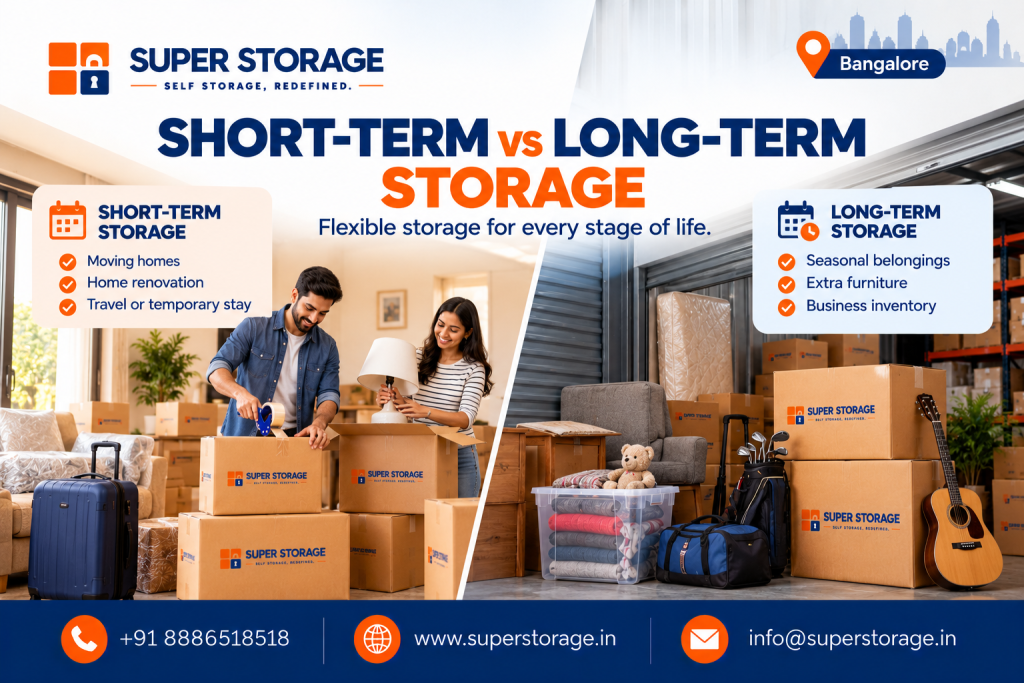
What Is Short-Term Storage?
Short-term storage refers to keeping belongings in a storage facility for a relatively brief period. This may range from a few days or weeks to several months, depending on the provider’s available plans and terms. It is particularly useful when you need temporary space because of a specific event or transition.
For example, you might need storage while moving between rental properties, renovating your home, waiting for your new apartment to be ready, or relocating to another city. Students may also need temporary space for their belongings during semester breaks or while moving between accommodations. Businesses can use short-term arrangements when shifting offices, managing temporary stock increases, or reorganising their premises.
The main advantage of short-term storage is flexibility during a period of change. Rather than making rushed decisions about furniture, appliances, or personal belongings, you can keep selected items elsewhere until you are ready to use them again.
SuperStorage offers storage options that customers can explore for different personal and business requirements. If you need space for a limited period, discuss your expected duration and item quantities with the team to understand the available arrangements and applicable terms.
What Is Long-Term Storage?
Long-term storage is suitable when you need to keep belongings outside your home or workplace for an extended period. Depending on the provider’s terms, this may involve several months or longer. It is useful for items that you want to retain but do not need to access regularly.
Households may choose long-term storage for seasonal furniture, spare beds, additional appliances, inherited belongings, or items they plan to use in a future home. People moving abroad for work or education may also need space for furniture and household goods they cannot take with them. Businesses may store archived records, spare equipment, or selected inventory that is not required for daily operations.
The primary benefit of long-term storage is that it provides an alternative to keeping unused belongings in valuable living or working space. Instead of filling spare rooms with boxes or renting a larger property, you can consider storing items that are not immediately needed.
SuperStorage provides storage options for accepted household, personal, and business belongings, subject to the available services and selected plan. If you expect to store items for an extended period, discuss the storage duration, pricing, conditions, and retrieval arrangements before making a booking.
Key Differences Between Short-Term and Long-Term Storage
The main difference between short-term and long-term storage is the expected duration, but several other factors can influence your decision. Short-term storage is generally associated with temporary situations such as relocation, renovation, travel, or a gap between property handovers. Long-term storage is more suitable when you expect to keep belongings away from your regular living or working space for months or longer.
Cost is another important consideration. Short-term arrangements may be suitable when you only need additional space briefly, while longer arrangements require you to consider the cumulative cost over time. Some providers may offer different pricing structures depending on the storage duration, so it is important to compare the complete quotation rather than assuming that one option will always be cheaper.
Access requirements also matter. If you expect to retrieve items frequently, ask how retrieval requests are handled and whether additional charges apply. If your belongings will remain unused for an extended period, you may prioritise suitable storage conditions, clear inventory records, and a straightforward return process.
SuperStorage customers can discuss their expected duration, the type of belongings involved, and their retrieval needs to understand the available options. Confirm the applicable terms before booking, particularly if your plans may change.
When Should You Choose Short-Term Storage?
Short-term storage is a practical choice when you know that your need for additional space is temporary. One common example is moving homes. Your current lease may end before your new property is ready, leaving you with furniture and boxes that cannot be moved directly into the next home. Temporary storage can help bridge that gap without forcing you to rush the move.
Home renovation is another situation where short-term storage may be useful. If contractors need access to bedrooms, living rooms, or the kitchen, moving selected furniture and appliances elsewhere can create more working space. Once the work is complete and the property is ready, you can arrange for the belongings to be returned.
Short-term storage may also suit people travelling for a few months, students between accommodation arrangements, or businesses that need temporary space during an office relocation. In each case, the goal is to manage a specific transition rather than permanently relocate belongings to an external facility.
SuperStorage helps customers explore storage arrangements for accepted items during relocation and other temporary situations. Before choosing a plan, estimate how long you will need the space and allow for possible delays. If your moving or renovation schedule is uncertain, ask about extension options and the charges that may apply.
When Is Long-Term Storage the Better Choice?
Long-term storage may be more appropriate when you have belongings that you want to keep but do not need in your everyday environment. For example, you may be moving from a large house to a smaller apartment and want to retain extra furniture until you purchase a larger property. You may also be relocating abroad for an extended period and need a place for selected household belongings.
Businesses can benefit from long-term arrangements when they need to retain certain items without using valuable office space. Archived paperwork, spare furniture, and selected equipment may not be required daily but could still be useful in the future. However, businesses should confirm that the provider’s conditions meet their requirements, particularly when storing confidential records or specialised equipment.
Long-term storage requires careful consideration of cost and item value. Before storing something for many months, compare the expected storage expense with the cost of replacing the item. If an item has little practical or sentimental value, selling, donating, or recycling it may be more economical than paying to store it indefinitely.
SuperStorage offers storage options customers can explore for different household and business needs. If you expect to store belongings for an extended period, discuss the total cost, storage conditions, accepted-item policy, and retrieval arrangements before confirming your plan.
What Items Can You Store?
The belongings you plan to store can influence which arrangement is suitable. Common household items include furniture, beds, sofas, dining tables, wardrobes, books, clothing, luggage, and selected appliances. Students may need space for personal belongings, while businesses may want to store accepted inventory, office furniture, or equipment.
For short-term storage, customers often focus on items needed during a transition, such as furniture during renovation or boxes during a move. For long-term storage, the focus may be on belongings that are not needed regularly but are worth retaining for future use.
Before packing, clean and dry your belongings, use suitable containers, and label boxes clearly. Create an inventory so you know what has been stored and can identify items when arranging their return. Fragile or specialised items may require particular preparation, so confirm the provider’s requirements before booking.
SuperStorage provides storage options for various accepted personal, household, and business belongings. However, not every item is suitable for every facility. Ask about restrictions and confirm that the provider can accommodate your particular items before arranging collection.
How to Choose the Right Storage Duration
Choosing the right duration begins with understanding your circumstances. Consider when you expect to need your belongings again, whether your timeline is fixed, and how much uncertainty surrounds your plans. If you are moving into a new property on a confirmed date, you may be able to estimate a relatively short storage period. If you are travelling abroad or waiting to purchase a home, a longer arrangement may be necessary.
It is also useful to consider whether your requirements may change. Renovation work can take longer than expected, travel plans may be extended, and businesses may need additional time to manage excess inventory. Ask the provider how extensions work, whether you need to give advance notice, and how additional time affects the price.
SuperStorage customers can discuss their estimated duration and storage requirements with the team. Reviewing the available plans and conditions in advance can help you avoid unexpected charges if your circumstances change.
Understand Storage Costs Before Booking
Storage costs can vary depending on the quantity and size of your belongings, the duration, the services selected, and the location. Collection, transportation, packing assistance, and return delivery may be included in some arrangements but charged separately in others.
When comparing short-term and long-term storage, request a quotation that clearly explains the total cost. Check the minimum storage period, payment schedule, extension charges, collection fees, and return delivery costs. If you expect to store items for many months, calculate the projected total rather than considering only the initial charge.
You should also review the service agreement to understand the provider’s responsibilities, accepted-item policy, access procedures, and applicable insurance or protection terms. This is particularly important when storing valuable furniture, business equipment, or other items that may require special handling.
SuperStorage helps customers explore storage options based on their requirements. Providing an accurate inventory, pickup location, and estimated duration can help the team explain the available arrangements and relevant charges.
How SuperStorage Can Help
Choosing between short-term and long-term storage becomes easier when you know what you need to store, how long you expect to store it, and when you may need it back. SuperStorage offers storage options for accepted household belongings, personal items, furniture, and selected business requirements.
Depending on the selected plan and service location, customers may also be able to arrange pickup and return delivery. These options can be useful when moving bulky furniture or several boxes, although availability and charges should be confirmed before booking.
Whether you need temporary space during a move or a longer arrangement for belongings you rarely use, discuss your requirements with SuperStorage. The team can provide information about available services, storage duration, pricing, and applicable conditions so you can make an informed decision.
Conclusion
Choosing between short-term and long-term storage depends on your circumstances, the belongings you need to keep, your expected timeline, and your budget. Short-term storage is useful for temporary transitions such as moving, renovation, travel, or office relocation. Long-term storage may suit belongings you want to retain but do not need in your everyday life.
Before making a decision, prepare an inventory, estimate your storage duration, compare the total cost, and confirm the provider’s accepted-item policy and retrieval arrangements. If your timeline is uncertain, ask about extension options so you can plan for possible changes.
SuperStorage helps individuals, families, students, and businesses explore storage options based on their requirements. Whether you need space for a few weeks or expect to store belongings for several months, contact SuperStorage to discuss your needs and request a quotation for the available services.